Tuesday, 4 August 2015

Off Page SEO Techniques That Will Boost Your Ranking


Now days SEO have many changes and Each year, Google changes its search algorithm around 500–600 times.

Their are two following Steps to Improve:

    Use of Social Media
    Quality Link Building

Use of Social Media:

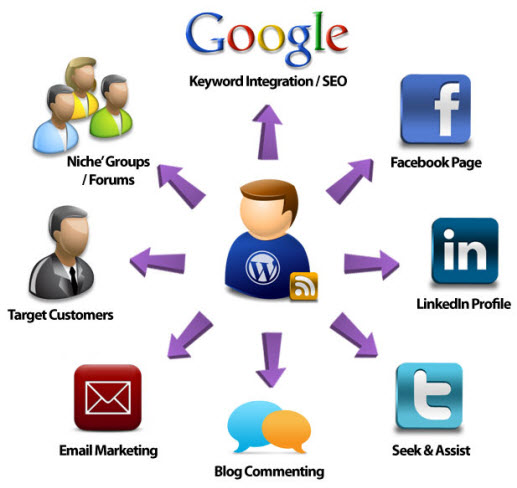
Social Media ia best way to drive traffic on your site .Use of Social Media not going to build follow back links but it's a powerful source to deliver traffic to the website. Traffic signal is also important factor in SEO so use the social media to get traffic.

In Social Media Examiner’s 2013 End of Year Report, marketers now place very high value on social media marketing:

    86% of marketers stated that social media is important for their business
    89% of marketers stated that increased exposure was the number one benefit of social media marketing

These are the definitive benefits of social media marketing that are listed:

    Increased exposure
    Increased traffic
    Developed loyal fans
    Generated leads
    Improved search ranking
    Grew business partnerships
    Reduced marketing expenses
    Improved sales
    Provided marketplace insight

Stats and Information about Social Media

Facebook is still the leading social media network and continues to grow. Here are the latest facts and figures:

    Facebook now has 1.26 billion users
    Facebook averages 1.23 billion monthly active users
    There are 128 million daily active Facebook users in the US
    Facebook averages 945 million monthly active mobile users
    Facebook usage is highest in North America: Facebook has 59% of all Internet users in North America as active users. Google+ only achieves 15% and Twitter 25%.


Google+ is now the second largest social network at just over 50%, with Facebook still dominating at 70%. Keep in mind that a Google+ account is mandatory whenever a person creates a new Gmail account. This is pushing up the account ownership stats. But no other social network has Google’s web assets leverage. Read more on how important Google+ is for Your Business and how it has a major impact on search engine results for your biz.

YouTube is more popular than cable television: YouTube reaches more adults than any cable network. In the United States, the number of people who watch television has fallen behind the number of people who watch YouTube on a regular basis. This makes it clear that televised content is undergoing a decline, online consumption of video is on the incline. Many companies have taken advantage of this by releasing their ads or marketing campaigns on YouTube first before they debut on TV. Take many of the 2014 Super Bowl XLVIII ads (like Budweiser) that were released on YouTube before the big game and were rewarded with triple YouTube views.

LinkedIn is still the largest professional business network and continues to grow but not at the pace of Pinterest,Google+ or

Pinterest is the fastest growing social network right now. The visual web is driving the rise of Pinterest and Tumblr with growth rates of 88% and 74% respectively over the last 12 months. Pinterest is also one of the leading referral sources for organic traffic, which is a good for high search rankings.

Twitter is an online social networking and microblogging service that enables users to send and read short 140-character text messages, called "tweets".

What are 2 key factors driving the social web in 2013 and 2014?

According to the Global Web Index study it is:

Mobile – the number of people accessing the Internet via a mobile phone increased by 60.3% to 818.4 million in the last 2 years. In the USA, there are now 101 million daily mobile users. Facebook’s 101 million US daily mobile users make up a whopping 78% of its 128 million daily US users.

Older user adoption – On Twitter the 55-64 year age bracket is the fastest growing demographic with 79% growth rate since 2012. The fastest growing demographic on Facebook’s and Google+’s networks are the 45 to 54 year age bracket at 46% and 56% respectively. So maybe that’s the reason your parents and grandparents aren’t visiting that much anymore — they are too busy on Facebook and Twitter!
Quality Link Building:

Nowadays Quality link Building a big challenge in SEO . Suppose If you have Site ABC.co.uk and you want to create quality link then Keep in Mind that your main target to create 60% Nofollow Link and 40 % Dofollow Link .

For it We follow the Given Trick :

LOCAL SEO: Local SEO is a highly effective form of local online marketing. It allows local businesses to promote their services to local customers at exactly the time they’re looking for your type of business. Local SEO uses search engines like Google and business directories like Yelp, Superpages, Qype & TouchLocal.

Local SEO Tools: Bright Local (http://www.brightlocal.com/) Moz Local (https://moz.com/local), Yext (http://www.yext.com/)

Article Submission: Use only High quality site for Article Submission and Article Content should be 1000 Words . Use Only Country and Thea,a Specific Article Directory for Article Submission.

Note:

    Try to make 60% No-follow Link and 40% Do-follow Article Link
    Use At Least One Information Site Like Wikipedia , Wiki-how Like Site
    Always Promote Brand name with Anchor Text Link
    Always Use Long Tail Keyword with Anchor Text Link

Use the Following Search Rule for Industry Based Article Site Search

Keyword + “recommended articles”/”suggested articles”
Keyword + “useful articles”/”interesting articles”
Keyword + “favorite articles”
Keyword + “news”/”industry news”
Keyword + “magazine”/”industry magazine”
Keyword + “journal”/”industry journal”

Web2.0 submission : Web 2.0 is a best way to create blog or mini websites. Where We can submit unique and interesting on web 2.0 platform. Nowadays it becomes most popular source to increase traffic and to create quality back links.

Example Of Web 2.0 Site:

    http://wordpress.com/
    https://www.tumblr.com/
    http://www.weebly.com/ etc

Giveaway Submission : A giveaway is a type of marketing promotion where something is given away for free. Companies often use giveaways to spread the word about their products, to make themselves more memorable in their customers' minds, or to get people to try something new in the hopes that they will continue to buy the product.

Example of Giveaway Site :

    http://www.giveawayoftheday.com/
    http://www.rafflecopter.com/ etc

Info-graphic : Information graphics or info-graphics are graphic visual representations of information, data or knowledge intended to present complex information quickly and clearly.

Online Info-graphic Tool:

    http://piktochart.com/
    http://infogr.am/

Create Promotional Video Ads : it is important that you create custom promotional materials, instead of simply using your existing YouTube videos. Create a compelling ad by staying creative and following these strategies:

    Keep it short– shoot for 30-60s.

    Show viewers what you’re all about– include clips of your content and make the ad is in the same style as the content on your channel.

    Make the first 5 seconds count – after this the user can skip your ad. Convince them to stay!

    Use Calls to Action (CTA – tell users exactly what you want them to do after watching your ad.

    Give users time to take that action – the last 10 seconds or more of your video should give users time to click. Create a static call to action, like an end-card for your ad.

    Give it a real title – ad titles are visible to the user so don’t call it an “ad.” Use this space to double-down on your CTA and name it something like “subscribe to my channel”.

    Upload to the channel you’re promoting – upload the ad as unlisted or public to the channel you’re trying to promote.

Video Submission Site:

    http://www.youtube.com/
    http://www.dailymotion.com/
    http://www.vimeo.com/ ETC

Friday, 31 July 2015

Seo Tip For Business Blog


In the previous article, I mentioned that blogging is upon the most effective content marketing tactics available. Blogging brings significant SEO values, therefore, by learning how to optimize a business blog correctly, we can maximize its full potential. I have already explained the importance of long tail keywords and described how to implement them into your content wisely, listed a few optimization rules for your visual content, and provided you with some tips for linking. Today, I am going to focus on other impactful components of your blog structure in terms of SEO.

 SEO-friendly pagination boosts your usability


When it comes to SEO and usability, pagination should be of your concern. Keeping all of your articles on a single, infinite page is not user-friendly; good pagination is. Pagination is a proper system for numbering pages and it helps to organize your posts, minimizes crawling depth, positively influences page load time and, finally, make your content more accessible for visitors. Additionally, correct pagination helps Googlebot crawl and index all of your content more effectively. Google itself serves the best example of SEO friendly pagination:


Sort your content into categories


Leverage the usability of your site by dividing your content into categories. Sorting your content into topic-themed pages improves the findability and creates extra opportunities for ranking in search engines. Besides, a category changes your particular permalink structure. It is wise to select only one category per post to avoid the risk of having duplicate content. In general, you should keep a limited number of categories on your blog. Choose a few broad topics and refresh them frequently, just like we, at Positionly, do:
Categories-Positionly-Blog

Suggest related, previous and next posts


Suggesting other related, previous, and next posts at the end of each article will quickly define your blog architecture. This will help the SEO juice circulate throughout multiple pages of your blog and strengthen the value of linked websites. Moreover, related posts indicate other relevant topics to your readers as well as to search engines. They also create a tight-knit network of pages which positively affects the navigation of your blog. As a result, you will gain additional visits to suggested content, increase quality indicators (average time on site), improve user engagement and, of course, reduce the bounce rate.


Add social sharing buttons


It is highly recommended to add social sharing buttons to your blog that enable quick content distribution across your social platforms. It can expose your content to new audiences. Moreover, there are SEO benefits of adding social sharing buttons due to the correlation between social sharing and following mentions or backlinks. Make sure that you provide visible and smooth sharing on your blog. You can add social sharing buttons throughout your post or use plugins like, for instance, Flare.
The most common placement options for social media buttons applied by popular websites are:

Positionly-Social-Shares-Bar-Placement


Worth noticing is a growing trend of tweetable links. By having tweetable links, your users can quickly tweet multiple ideas from the article. There are many free plugins available for WordPress, for example ClickToTweet, which seems to be one of the most popular at the moment. The bottom line is to make sharing your content extremely easy.

#9 Take advantage of a sidebar 


A sidebar is an important piece of your well-optimized blog. It is the area next to your article which you can use to promote yourself and your products or services. It is necessary to link to your most popular guides or posts from the sidebar because it helps distribute SEO juice to those pages and influences their search ranking. In order to build a loyal community and get repeat visits, add an email subscription box, your social links, and a short description of your company. The correct placement for a sidebar is at the right side of  each single blog post page because it won’t draw attention away from your text. Take a look at


 Comments add significant value to your SEO campaign


User-generated Content (UGC), which is created by comments on your blog, is a very valuable asset that can help you rank your long tail keywords. Letting your readers leave comments below your blog post gives you a clear overview of how your company is perceived on the market and what your customers say about your product or service. The language and wording your users use, especially the repeating phrases across different comments and pages, can be identified as new long tail keywords and add a significant value to your on-page optimization. Moreover, your quick feedback can build brand loyalty and display the fact that you provide  valuable customer service. Keep an active dialogue with the target audience because regular user interactions can become a steady source of unique content and improve the performance of your website on SERPs.

 Content is the king


Above all the structural tips, it is content that matters most. Sure, people scan the content, which is why you should shape it in a scannable way, but they also read it, and your task is to craft it to the best possible standard. Keep it useful, concise and simple. However, the longer your content becomes, the more gets indexed by Google spiders. Google prefers comprehensive articles and this is why extensive blog posts are usually better ranked. Just take a look at the picture below presenting the average content length of the top 10 results and evaluate the correlation:

Average Content Length of Top 10 Results


Refresh your content regularly and show Google that your website is alive. Search engines crawl active websites more often and they are more appealing to place in the search results. That is why you should make sure to publish fresh content on a regular basis.
Conclusion

Positionly’s On-Page Optimization Grader is a very useful tool for checking if your blog post page is well-structured from the SEO point of view. All you need to do is insert the page address and type in the targeted keyword(s) (optional), and you will be provided with the results and given advice on what should be fixed. Test this and the many other tools in our collection and start your free 14-day trial today!
optimization-check

The knowledge I have provided in the last two articles is absolutely essential for any business blog. User-friendly pagination, the suggesting of other posts, sorting your content into categories, adding social sharing buttons, sidebar implementation, enabling user-generated content and other content rules, combined with the SEO tips given last Thursday, are necessary pieces of a whole which can ultimately bring you a step closer in becoming a SEO master.

If you have any questions concerning this topic, feel free to comment and I’d be happy to help you out.

Thursday, 30 July 2015

How to Super Boost your Blog Search Engine Ranking


1. Keyword Research

The first step of an SEO process is a keyword research. With keyword research you try to determine which keywords or phrases people are using to search your blog or competitor’s blog as well as then make a decision which ones to target.

    Focus on High Volume with Low Competition:

    Perfectly, the keywords with the higher potential are the ones with a high search volume, however with a low competition. Unluckily, as generally also the competitors are doing a like research, these keywords are limited as well as there are not sufficient to maintain a full SEO campaign.

    Add Long Tail Keywords:

    In such cases, it is suggested to target the “long tail” of keywords. At the present time, most searches are not 1-keyword long, but 2, 3 or even 4 keywords long. All individual searches may have a low search volume, but generally the competition is lower, therefore it is easier to rank along with the first positions.

    Do a Competitive Analysis:

    It is also essential to analyze the blogs of your competitors, in order to determine new keywords to target.

2. Technical Optimization

Search engines use special software called crawlers, in order to observe your blog’s text as well as code. If your blog is not precisely perfect, it may be complicated for a crawler to examine as well as understand all of your blog content and it may have as a result that your blog pages will rank lower in the search engines results pages, or even worst, not at all. It is significant though that the following technical points are checked.

    URL Structure:

    Good SEO perform for URLs is to maintain them under 100 characters long, to use dashes instead of underscore as well as to keep away from special characters.
    Title Tags:

    Every blog page should have a unique Title Tag, 65-75 characters long. It is also significant that the basic keywords be present in the beginning of the title.

    Meta Description Tags:

    A Meta Description Tag should be unique for each page, up to 160 characters long as well as contain 1-2 sentences that explain the page.

    Heading Tags:

    Headings are part of the HTML of a page and they are noticeable to the blog visitors. There are 6 different headings, from H1 to H6. Each page should have only one, distinctive H1 heading tag.

    Duplicate Content:

    Duplicate content problem arise when the exact same content be present in your blog under 2 or more different URLs. This can have a harmful effect for blog ranking, as search engines do not know which version to comprise in their index. 
It is though suggested to solve any duplicate content problem in your blog, by removing the duplicate content or create redirections among the multiple versions.

    Structured Data:

    With structured data, you can add unique markup to your article, so that search engines can without difficulty understand its type. This can potentially help to get higher rankings. It can also suggest rich snippets for your blog pages in the search results pages. Rich Snippets give a small sample of the page’s article in the results pages of search engines, building it more famous.
In http://www.schema.org, you can find out different schemas for different types of article, like articles, movies, products, events, persons of organizations as well as use them in your blog.


    Sitemaps:

    Search engines exploit the XML sitemap protocol, so it is significant that your blog contains an XML sitemap. After its making, it has to be submitted in Google Webmaster Tools, so that all of the blog’s article its crawled. It also has to be updated as well as re-submitted every time new article is added in the blog.

    Rich Media:

    Every image should have an associated tag. This is an HTML tag that let to briefly describing the article of the image, so that search images can easily understand it. It is also supportive to use related keywords for the filename, instead of random letters also numbers.
For videos you can add the transcription text and add a video sitemap in your blog.

3. Usability

Search engines try to provide to their user’s results that are helpful as well as assure them. For this basis they take into account the engagement metrics of a blog. As Google recommends “In general, webmasters can increase the rank of their blogs by creating high-quality blogs that users will want to use as well as share”. You should maintain the following usability tips in mind:

    Overall Appeal:
    Usability includes things like visibly labeling different parts of the blog so visitors can easily find their way around, building important areas of the page easy to spot or making it easy to find contact information.

    Navigation:

    Search engines may rank a huge number of a blog’s pages at the same time, which means that people will be able to access a blog from pages other than the home page. Lacking of good navigation that covers the whole blog, visitors could acquire stuck on a page and not be able to move on to explore more of a blog.

    Information Architecture:

    Information Architecture is the frame of your blog from which all other aspects are built – including form, function, navigation as well as interface, communication, and visual design.

    Content Quality:

    For usability reasons, no page should ever be longer than 800 words with the exception of blog posts. This article needs to include the relevant keywords for the page. Having unique and keyword rich text on a page can help to increase search engine rankings extensively.


4. Content Marketing

As Google always updates and optimizes its algorithm in regulate to provide the best results to users, it gives more and more significance to useful, fresh as well as engaging content. Nowadays, quality content is the base of a successful SEO campaign. It is significant thought for every blog to invest in the making of fresh, appealing and quality content, like the following:

    Blog:

    Fresh as well as useful content can rank high in search engines. It can also be a method to get new links and boost the authority of the whole blog, when people are sharing it.
    Guides, Ebooks, or other Useful Content:
    These are parts of content that require more effort, but if they are promoted properly they can help to bring new links for several months after their establishment.
    Infographics, Charts, or other Visual Content:
    Again, this is a kind of content that can attract new links to a blog. It is best method to Boost your Blog Search Engine Ranking.

5. Social Media Strategy

According to current studies social signals are among the most significant ranking factors. That means the social media are at this time a strong influencer for SEO as well as it should be part of an SEO campaign. The steps of a booming social media tactic are the following:

    Setup your target for Social Media:

    These could be for instance increasing the size of the group of people and gain more publicity for your content.
    Understand your Audience:

    Before start being active in social media, you should research as well as understand the users that are paying attention in your market.

    Choose your Social Media Channels:

    There are so many different social media channels accessible, that it’s impossible for a blog to be successful on all of them. For the beginning, choose 3 to 4 channels where your target viewer is active.

    Connect with Influencers:

    People with a lot of followers in social media can be helpful, for the reason that they can spread your message to more people. Find them as well as try to connect with them.

    Make a Social Media Posting Plan:
    For each channel, make a decision how often you will post and what kind of article you are going to use.

6. Link Building

Even if now Google tries to be relevant stricter rules to links, they still continue a very significant ranking factor. Links boost the authority and trustworthiness of a blog. The total number of links is essential, but it is similarly important to get links from a multiplicity of popular and reliable domains. Just bear in mind that the most significant search engines have strict rules against unnatural or paid links, so the link building method consists generally from actions that attract links from reliable sources in a natural method. There are dozens of method for link building; here are the most basic ones:

    Guest Blogging:

    This is a great method to create useful links. It is essential though to avoid performing high volume as well as low quality guest blogging, for the reason that Google may think about these links unnatural. High excellence guest blogging using original article is the one that works most excellent and can bring best results.

    Contests or Giveaways:

    A contest or a giveaway is a great method to bring traffic as well as increase responsiveness for a blog, but also to make new links.

    Broken Link Building:

    With this method, you find recourse pages connected to your blog and you check the links on this page, locating any broken ones. After that, you contact the blog’s owner, informing him about the broken link as well as asking him to replace it with a link to your blog.


How to Customize the Facebook Page Plugin for Websites

The other difference that you can now only display a single row of fan pictures inside the Page Plugin. Why does this matter? The pile shows profile pictures of mutual friends who have liked your Facebook Page and thus, when a casual visitor sees a familiar face inside that pile, it is likely to increase their interest in your website.

What you see here are a list of customization options now available inside the Facebook Page plugin. You can choose to have a simple Like box with just your logo and like button or you can have a complete box with cover photos as well.


Customizing this Facebook Page plugin is simple as detailed in the official documentation. For instance, if you would not like to show a cover photo, set the HTML5 data attribute data-hide-cover to false in the DIV tag. Setting data-show-facepile to false will hide the row of pictures.
Similarly, you can attach styles to the .fb-page class to customize the outer of the Facebook Plugin. For instance, if you like the steps style I use here with the Facebook box at Immortal Technologies this is the underlying CSS code

Tuesday, 28 July 2015

Best 5 Methods to Optimize Google Adsense for Increase Income

Think About the Position & Style of your Ads

    Look at the Style of Ads Existing- Some Blog report enhanced income potential from skyscraper ads determine 160 x 600 pixel, as of large rectangle ads among 336 x 280 pixels or from an inline rectangle among 300 x 250 pixels.

Note- A skyscraper is a particular type of advertisement that place ads vertically along the side to your blog.

    Select the Style of Ad you want to use and Analysis it – If you feel like you are not getting the result after a month, think about that switching to a different style.

You Can Also Read-

    How To Get Google Adsense Approval with a New Blog


Optimize Adsense with your article

1. Plan your Blog Article with Adsense in Mind- Google provides many tools to help its users improve their income. One of these tools provides details on keyword and the average amount you can earn from those Keywords.

2. Write SEO Content with Higher Paying Keywords

    This has the prospective to enhance traffic to your blog and to get higher paid advertisement for the ads displaying on your blog page.

    SEO content can embrace factors not seen on the blog page, as well as the use of Meta tags, robots.txt files and Blog maps.

3. Things You’re Writing to your Audience & not to Adsense – In order to keep your traffic on your blog, you need to offer high quality information to your users or visitors. This will drive traffic back to your blog, which can increase your income through increased experience.


You Can Also Read-

    Top 10 Most Profitable High Paying Niche in Google Adsense

Utilize Research for Ad Design


1. Make your Ads Appealing to your Visitor- When you can’t control every factor the ads, there are some Factors you can do….

    When the most popular link color is blue, you may get that more people click on the ads if you use a link color so as to matches the other links on your blog.

2. Think About the Impact of Border for your Ads

    Some Adsense users suggest using no Border around ads when you use a light Colored background. While you make use of darker Background, the consensus is to border your ads.

    As well, using border for in-text ads can divert users or visitors, when bordering ads on the sides of your blog page can draw positive awareness to the ads.

Disable Onsite Advertiser Sign Up

    Evaluate Whether or not You feel this needs to be done- Some Blogger prefer to disable it because it makes a negative impact on the advertising. Others don’t make out it as a problem.

    Sign in to your Google Account for Google Adsense.

    Go to “My Account”- This Must is in the Control Panel.

    Find the “Onsite Adversisen Sign Up “and Disable it- In most cases, you will need to uncheck the box next to it.

Add a Search Box

    Increase Income From Ads that Display when people search for something from your blog- In Most cases, the ads displayed add up as part of your income program.

    Log In at Google Adsense.

    Find the Adsense Setup and Go to Adsense for Search

    Customize your Search Box among Design features like your Blog Logo or Company Picture.

    Incorporate the Offer Code into your HTML page- you can do this by cutting and pasting into your Html and after that uploading it to your Server

Saturday, 25 July 2015

Google Ranking Factor


On-Page factors:

The way your page is optimised has the most profound effect on its rankings. Here are the page optimization factors that can affect its search visibility:

Keyword in title tag.

 The title meta tag is one of the strongest relevancy signals for a search engine. The tag itself is meant to give the accurate description of the pages content. Search engines use it to display the main title of a search result. Including a keyword in it will indicate to search engine what to rank the page for.
Ideally, the keyword should be placed at the start of the title tag. Pages optimized this way will rank better than those with keyword closer to the title’s tag end.

Keyword in description tag.

The importance of the meta description tag today is often discussed in SEO circles. It is nonetheless still a relevancy signal. It is also crucial for gaining user clicks from search results pages. Including keyword in it makes it more relevant to a search engine and a searcher.
Keyword in H1 tag. H1 tag is yet another relevance factor, serving as a description of the pages content. In spite of an ongoing discussion about its importance, it is still a good practice to include your keyword in a unique H1 tag on a page.


Using keywords in the pages copy.

 Up until not long ago, stuffing your page with keywords was a surefire way to increase its rankings for a particular keyword. That’s not the case anymore. Using the keyword in the copy still sends a relevancy signal of what the content is about. How you place it however has changed drastically.

Length of the content.

These days searchers want to be educated and won’t satisfy with basic information. Google therefore looks for authoritative and informative content to rank first. And it’s a common sense that the longer your content is, the greater the chance that you can cover more aspects of your topic. Don’t be shy of writing long but highly useful copy then.

Duplicate content.

Not all factors can influence your rankings in a positive way. Having similar content across various pages of your site can actually hurt your rankings. Avoid duplicating content and write original copy for each page.
Canonical tag. Sometimes however having two URLs with similar content is unavoidable. One of the ways from preventing this from becoming a duplicate content issue is by using a canonical tag on your site. This tag does one simple thing, it tells Google that one URL is equivalent of another, clearly stating that in spite of two pages having the same content, they are in fact one.

Image Optimization.

It’s not only text that can be optimized on a page but other media too. Images for instance can send the search engine relevancy signals through their alt text, caption and description for instance.
Content Updates. Google algorithm prefers freshly updated content. It does not mean that you have to edit your pages all the time. I believe that for commercial pages, such as product descriptions Google recognizes the fact that they are not as time sensitive as blog posts covering recent events. It is wise however to include some strategy to update certain types of content once every 12 months or so.
Outbound links. Linking to authoritative pages sends trust signals to the search engine. Think of it this way, the only reason why you would send a user to another site is if you wanted them to learn more of the subject. This can be a huge trust factor for Google. Too many outbound links however can greatly diminish the page’s PageRank, hurting its search visibility. Outbound links can affect your rankings but use them in moderation.

Internal links.

Interlinking pages on your site can pass their strength between them.
Keyword in URL. Including keyword in the URL slug (that’s the bit that appears after the “.com/“part of the URL) is said to send another relevancy signal to Google.
Site factors:
There are certain site wide factors that can affect your sites search visibility as well:

Sitemap.

 A sitemap helps search engine to index all pages on your site. It is the simplest and most effective way to tell Google what pages your website includes.
Domain trust. Trust matters. It’s hard no to think that sites Google trusts should rank higher. But how do you build that trust? Brian from Backlinko has a full list of trust factors here. Needless to say, building trust factors of your domain will certainly pay off.
Server location. Some SEOs believe that a servers location helps to boost rankings for that specific country or region.

Mobile optimised site.

Only a year ago, 46% of searchers used mobile exclusively to research. I believe this number increased exponentially in the last 12 months. It would be no surprise then that having a mobile optimised site would affected rankings in some way.
Google Webmasters Tools integration. Lastly, having your site verified at Google Webmasters Tools is said to help with your sites indexing. Even if that’s not the case, the tool provides valuable data you can use to better optimise your site.
Off Page factors:
When ranking your pages, Google looks at factors outside of your site as well. Here are some of the key ones:

The number of linking domains. The number of domains linking to you is one of the most important ranking factors.
The number of linking pages. There might be a number of links from a particular domain to your site, their number is a ranking factor too. However, it is still better to have more links from individual domains rather than from a single domain.

PageRank of linking page

. Not all pages are equal. Links on pages with higher PageRank will be a bigger factor than those on low PR pages. Therefore, you should strive to build links from high PR pages.
Link relevancy. Some SEOs believe that links from pages related to your pages topic carry more relevancy for search engines.

Authority of linking domain

. Similarly to a page PR, the authority of a domain may be a ranking factor too. For that reason, a link from low PR page on a high PR site will be worth more that from a lower PR one.
Links from homepage. Similarly, some SEOs believe that links from a home page of a linking domain carry more strength than those on one of its pages.
Number of dofollow vs. nofollow links. Google officially stated that they don’t count nofollow links (link with rel=nofollow attribute attached). Therefore the number of your do follow links should affect your rankings too.

Diversity of link types.

The types of links you build to your site matters too. Too many links of one type may be a spam indicator and impact your rankings negatively.
Contextual links. It is said that links within the content of the page are worth more than links in a sidebar for instance.

Link anchor.

 Anchor text of a link used to be a strong ranking factor. Today it can be used as a web spam indicator, negatively impacting your rankings.

Domain factors:
Lastly, your domain can affect your rankings as well. Some of the domain signals aren’t as strong as they used to be, there are few things worth paying attention to:

Domain registration length. Google considers domains registered for longer than a year as more trustworthy. QUOTE.

Domain history.

 You may not be the first person who registered the domain. And if your domain has been penalised in the past, its history might affect its current rankings
.
Country TLD extension. If you try to target a specific local market, it is said that having a domain with a country specific TLD (.pl, .co.uk or .ie for insance) will help to achieve better rankings for that location.

Thursday, 23 July 2015

How to Optimize for App Store Search Engines


App Title

An app's title is the single most important metadata factor for rank in ASO. It's equivalent to the <title> tag in your HTML, and is a great signal to the app stores as to what your app is about. On the web, you want your title to include both a description of what you do (including keywords) as well as some branding; both elements should also exist in the app store. Be sure to include the keywords, but don't be spammy. Make sure it parses well and makes sense. Example: "Strava Run - GPS Running, Training and Cycling Workout Tracker"

Description

Patrick Haig, our VP of Customer Success, likes to break descriptions down into two sections: above the fold and below the fold (sound familiar?). He says, "Above the fold language should be 1-2 sentences describing the app and its primary use case, and below the fold should have a clear and engaging feature set and social proof." We'll dig into some of the differences about the description field across platforms below.

Keyword Field

The Keyword Field in iOS is a 100 character field which you can use to tell iTunes search for which keywords you should show up. Since you only get 100 characters, you must use them wisely. A few tips:
  • When choosing your keywords, just like on the web, focus on relevancy, search volume, and difficulty.
  • Don't use multiple word phrases; break out to individual words (Apple can combine them for you).
  • Don't repeat keywords that are already in your title (and put the most important ones in your title, leaving the keyword field for your secondary keywords).
  • Separate keywords with commas, and don't use spaces anywhere.

Icon


Consumers are finicky. They want apps which are beautiful, elegant, and simple to understand. Your icon is often their first interaction with your app, so ensure that it does a great job conveying your brand, and the elegance and usefulness of your app. Remember, in search results, an icon is one of the only ways you can convey your brand and usefulness. Think of it as part of the meta description tag you'd create in SEO. For example, SoundCloud does a great job with their icon and branding.

Screenshots

The most important rule to remember when creating your screenshots is that they should not be screenshots. They are, instead, promotional graphics. That means you can include text or other graphics to tell your app's story in an interesting, visual way.
Especially in iOS, where the card layout shows your first screenshot, it is incredibly helpful when an app displays a graphic which explains the app right up front, increasing conversions from search results to viewing the app page and, ultimately, installing the app.


Off-Metadata

Outside of your direct control, you'll also want to focus on a few things to ensure the best performance in ASO.

Ratings


Every app has a rating. Your job as a marketer is to ensure that your app gets a great overall rating. Rating is directly tied to performance in app store search, which leads us to believe that rating is a factor in app store search rankings.

Reviews


Similar to ratings, you want to ensure that the reviews your users write about your app are positive. These reviews will help increase your conversion rate from app page views to downloads.
For a great product to help you increase your rating and reviews, check out Apptentive.

Link-building


This is discussed further below, but suffice it to say, link building to your app's page in the app store matters for Google Play apps. Given you all are SEOs, you know all about how to rock this!

How Do iOS and Google Play Differ In App Store Search?


The differences in the platforms mean that there are different levers to pull depending on the platform. Google Play and iOS act completely independently, and often, quite differently. The differences are wide-ranging, but what are a couple of the main differences?
In general, the way to think about the differences is that Google is Google and Apple is Apple. Duh, right?

Description versus Keywords


In iOS, there's a keywords field. It's easy to see where this came from, especially when you think of iTunes' background in music: a song has a title (app title), musician (developer name), and then needs a few keywords to describe the song ("motown," "reggae," etc.). When Apple launched their app store, they used the same technology that was already built for music, which meant that the app title, developer name, and keywords were the only fields used to understand search for an app. Note that description isn't taken into account in iOS (but I expect this to change soon).

Leveraging PageRank in Google Play


Another big difference in iOS and Google Play is that Google has access to PageRank and the link graph of the web, while Apple does not. Thus, Google will take into account the inbound links to your app's detail page (for example, https://play.google.com/store/apps/details?id=com.symantec.mobilesecurity) as a factor in Google Play search, while Apple has no such factor.